

Your job title is a ceiling, not a badge of honor. Relying on a static label to define your professional worth is a high-risk strategy that leaves significant money on the table. Most high-level professionals feel trapped by generic designations that fail to communicate their true complexity. You likely know you're capable of more, yet you're often overlooked for high-paying niche roles because your resume speaks the language of an outdated organizational chart. It's time to stop trying to fit into a box that wasn't built for your unique trajectory.
We recognize the frustration of possessing cross-disciplinary expertise that traditional hiring systems can't quantify. This guide will show you how to dominate the skill stack vs job title shift by building a data-driven inventory of your actual capabilities. You'll learn how to bypass the limitations of a standard role and construct a strategic map that commands higher market rates. We'll provide a clear framework to audit your skills, validate your value against live market demand, and unlock the hidden opportunities that generic titles consistently miss.
Key Takeaways
- Stop letting administrative labels cap your earnings. Recognize that job titles aren't designed to reflect your value; they're tools for corporate standardization.
- Master the skill stack vs job title transition to identify the rare, cross-disciplinary combinations that command premium market rates.
- Uncover your "Shadow Skills." These are the hidden capabilities you use to solve complex problems that traditional resumes consistently overlook.
- Shift from a role-seeker to a strategic solution-provider by validating your professional intelligence against real-time market demand.
- Build a data-driven map of your expertise to bypass generic recruitment filters and access high-paying, niche opportunities.
The Job Title Trap: Why Your Label is Limiting Your Earning Potential
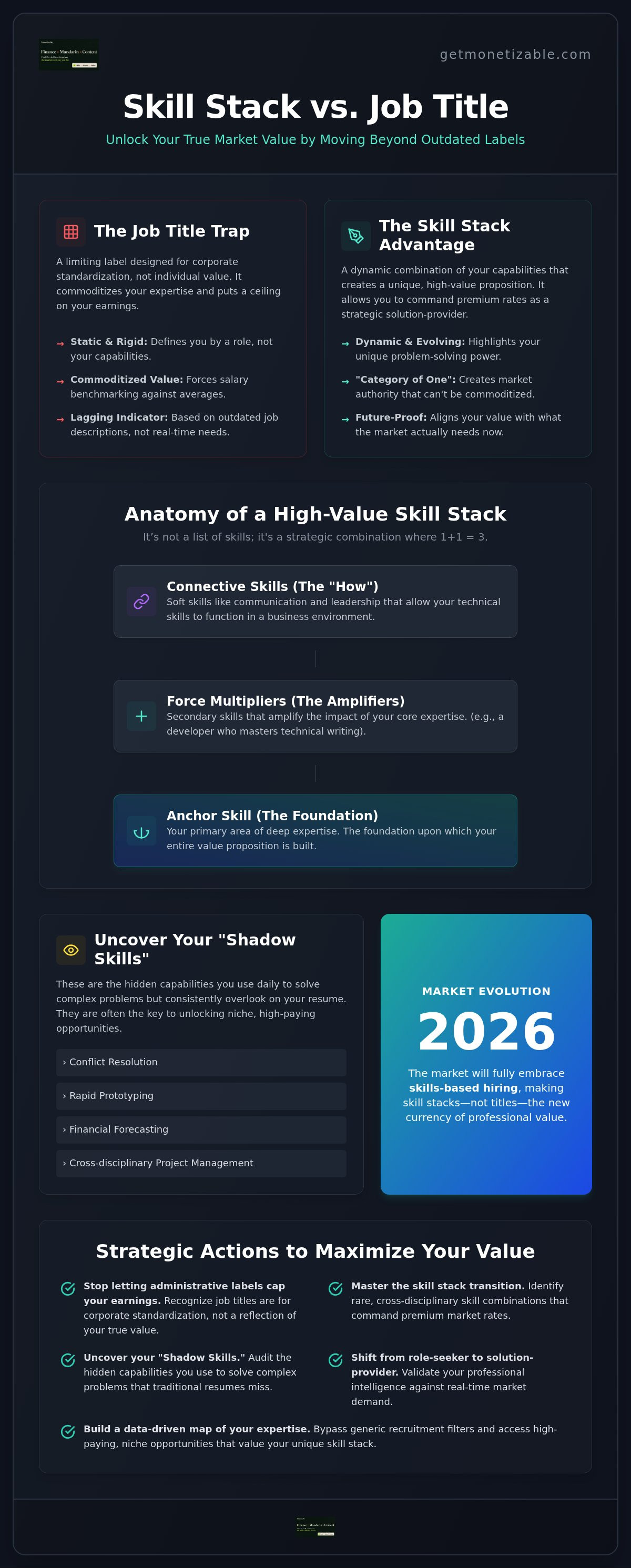
Job titles are administrative shortcuts. They exist to help HR departments categorize human capital into predictable, budget-friendly buckets. When you define yourself by a title, you're essentially handing over the keys to your earning potential. You're allowing an organization to benchmark your value against a generic market average rather than your actual output. This is the core tension in the skill stack vs job title debate: one is built for corporate standardization, the other for individual value optimization.
The "Senior Manager" paradox illustrates this perfectly. You might be a manager who possesses a deep understanding of cloud architecture and behavioral economics. However, on a spreadsheet, you're just another "Senior Manager." Your high-value, niche expertise is effectively invisible. By 2026, the market will have fully embraced skills-based hiring, moving toward "Atomic Skills" where the specific combination of your capabilities matters more than your previous rank. Staying stuck in a monolithic role creates a financial drag on your career that is difficult to overcome through simple promotions.
The Commoditization of Professional Labels
Leading with a title invites companies to benchmark your salary downward. It forces you into a commoditized pool where the goal is to find the most "standard" version of a role for the lowest price. Modern hiring is shifting from role-based to project-based models. This means businesses are buying solutions, not titles. Your LinkedIn headline is likely your biggest monetization bottleneck; it acts as a filter that hides your true complexity from the people who need it most. If you want to command premium rates, you must stop presenting yourself as a commodity.
The Wage Ceiling of the Traditional Job Description
Job descriptions are lagging indicators of market needs. They're often written by people who don't fully understand the technical requirements of the problem. This creates a risk where you're labeled "overqualified" for a title even though you're "perfectly stacked" for the actual challenge. Understanding the skill stack vs job title shift is the only way to break through these artificial ceilings. Job titles are the legacy code of careers, restricting modern professional performance with outdated scripts that no longer serve the high-speed economy.
Decoding the Skill Stack: The Sum is Greater Than the Parts
A skill stack isn't just a list of bullet points on a resume. It's a strategic combination of complementary skills that creates a unique value proposition. Think of it as the difference between being a commodity and being a category of one. While a job title is a static label, a skill stack is a dynamic engine for value creation. This is where the skill stack vs job title debate shifts from theory to financial reality. You aren't just what you do; you're the unique way your capabilities interact to solve problems.
Consider the "1+1=3" rule. When you combine two seemingly unrelated fields, such as Data Science and Psychology, you don't just have two skills. You have the rare ability to predict human behavior through quantitative analysis. This synergy creates market authority that a single job title can't capture. Most professionals are "Skill Hoarding," collecting certifications like trophies. Strategic skill stacking, however, focuses on how those skills interact to solve specific, high-value problems. It's about intentionality, not just accumulation.
Many of your most valuable assets are likely "Hidden Skill Stacks." These are the competencies you use daily to navigate complex projects but never think to list. You might use conflict resolution, rapid prototyping, and financial forecasting simultaneously. Because these don't fit neatly under a standard role, they remain invisible to recruiters. Identifying these unseen layers is the first step toward mapping your hidden value for the modern market.
The Anatomy of a High-Value Skill Stack
Every effective stack starts with an "Anchor Skill." This is your primary area of expertise; the foundation upon which everything else is built. From there, you add "Force Multipliers." These are secondary skills that amplify your primary output, such as a developer who masters technical writing to lead teams more effectively. Soft skills act as the connective tissue. They allow technical stacks to function in real-world business environments. Without this layer, even the most advanced technical stack remains siloed and underutilized.
Rare Skill Combinations: The Key to Niche Authority
In the 2026 digital economy, rarity will be more profitable than mastery. Being the 100th best Python developer is less valuable than being the only person who understands Python, supply chain logistics, and environmental law. Utilizing "Skill Combination Mapping" allows you to find these unique market positions where competition is non-existent. When you stop competing on the skill stack vs job title axis and start competing on unique utility, your income potential shifts from an HR bracket to a direct reflection of the value you provide.
Skill Stack vs Job Title: Where the Real Market Value Lives
Market value isn't a fixed number assigned to your resume. It's a calculation based on the scarcity and utility of your output. When you look at the skill stack vs job title comparison, the financial disparity is stark. A job title represents a market average; it's the baseline salary a company is willing to pay for a standard set of expectations. A validated skill stack, however, commands premium rates because it targets specific, high-stakes problems that generic roles can't solve. Buyers don't pay for people with impressive titles. They pay for solutions to urgent bottlenecks.
This shift introduces the concept of "Skill Liquidity." If your identity is tied to a title, you're locked into a specific industry vertical. If your value is tied to a stack, you can pivot between industries instantly. You aren't just a "Marketing Manager" in retail; you're a specialist in behavioral analytics, automated lead generation, and crisis communication. This combination is valuable in healthcare, fintech, or aerospace. You're no longer limited by tenure or corporate ladders. You're guided by evidence-based career growth where data proves your value before you even step into a room.
The ROI of a Validated Skill Stack
Specific stacks consistently command significantly higher rates than generic titles. Professionals who position themselves through validated combinations often see earnings at least 20% higher than those relying on standard role designations. This creates a powerful "Arbitrage" opportunity. You can take a skill combination that's common in tech and apply it to an industry like traditional manufacturing that desperately lacks that specific intelligence. Quantifying this cross-disciplinary value is the fastest way to escape the trap of the annual 3% raise.
Market Demand Validation vs. Job Board Scrolling
Traditional job boards are fundamentally flawed. They only display what companies think they need based on outdated templates. They don't reflect the real-time shifts in the economy. Relying on them is a reactive strategy that keeps you one step behind. Using Live Market Demand Validation reveals the unspoken needs of buyers, the skills they're actually hiring for but haven't yet codified into a job description. Transitioning from a job seeker to a value provider requires moving beyond the listings. By utilizing Monetizable Opportunity Matching, you align your skill stack vs job title strategy with live demand, ensuring your positioning is always backed by market intelligence rather than hope.
Strategic Mapping: How to Audit Your Professional Intelligence
Auditing your professional intelligence is a clinical, data-driven process. It requires you to strip away the vanity of your current title to reveal the raw machinery of your expertise. In the skill stack vs job title paradigm, your title is merely the packaging; your skills are the actual product. To optimize your earning potential for 2026, you must deconstruct your professional output into atomic units. Move beyond vague statements like "I manage a team" and toward specific actions like "I execute high-stakes resource allocation and cross-disciplinary conflict resolution."
Identify your "Shadow Skills." These are the invisible competencies that actually drive your results. They include the cross-functional communication frameworks you've built and the rapid decision-making models you use under pressure. Once these are surfaced, map them against live market demand data. This identifies your "Monetization Gaps." These gaps represent the specific points where your current market positioning fails to capture the full financial value of your actual output. Identifying these gaps is the first step toward reclaiming your market authority.
The Professional Skill Audit
Treat your LinkedIn profile as a raw data source for analysis. Export your history and look for recurring themes that fall outside your official role. Use Skill Combination Mapping to visualize how these capabilities overlap and create unique utility. A common mistake is including low-value skills that dilute your brand. Listing basic software proficiency alongside high-level strategic intelligence signals a lack of professional focus. Remove the clutter. You need your high-impact stack to stand out to the buyers who are looking for specialized solutions, not generalist support.
Validating Your Stack Against 2026 Market Needs
Static salary reports are historical artifacts. They tell you what people were paid last year; they don't tell you what buyers are desperate for right now. To stay ahead, you need Live Market Demand Validation. This process identifies exactly where buyers are already paying premium rates for your specific skill combination. A Professional Value Assessment provides a much more accurate reflection of your real-world market worth than a standard corporate performance review. It moves the conversation from "what you did" to "what you're worth on the open market."
Stop guessing your worth based on outdated HR labels. You can validate your skill stack today and see exactly how your professional intelligence aligns with real-time market opportunities.
Monetizing the Stack: From Hidden Potential to Live Opportunities
The transition from analysis to action is where most professionals stall. You've audited your intelligence; now you must deploy it. Monetizable Opportunity Matching represents the next evolution in career intelligence. It moves you past the passive act of waiting for a role that fits your title. Instead, you actively target the market demand that fits your stack. This is the definitive end of the skill stack vs job title conflict. You're no longer a candidate seeking permission; you're a strategist providing a specific, validated solution.
Presenting your stack to the market requires a shift in language. Stop describing what you "are" and start describing what you "unlock." Buyers in 2026 don't care about your previous title. They care about the intersection of your capabilities. Modern SaaS intelligence allows you to uncover high-paying niche paths that are invisible to the naked eye. These paths often exist in the gaps between traditional industries. By moving from simple analysis to active market participation, you secure a position based on utility rather than tenure.
Beyond Traditional Employment: Freelance and Pivot Paths
Skill stacks are the ultimate tool for industry-agnosticism. They enable high-rate freelance opportunities by allowing you to solve specific problems across multiple sectors. If you possess a rare combination of logistics expertise and cybersecurity, you aren't limited to a single career path. You can pivot seamlessly because your value is portable. The Monetizable approach focuses on matching your stack to real-time demand. This ensures your career roadmap is built on a foundation of data rather than speculation or outdated role descriptions.
Building Your Data-Driven Career Roadmap
Your roadmap should be a living document. It shouldn't rely on the slow, unpredictable cycles of corporate promotions. Use Live Market Demand Validation to benchmark your worth during every salary negotiation. This data gives you the leverage to walk away from low-value offers that ignore your cross-disciplinary intelligence. It's time to stop guessing and start knowing. You can analyze your hidden skill stack and validate your market value today. Stop letting an outdated skill stack vs job title mindset limit your 2026 earning potential. Take control of your trajectory with precision intelligence.
Secure Your Market Authority for 2026
Your professional value is too complex to be captured by a standard HR label. By deconstructing your expertise into a strategic stack, you move beyond the commoditized salary brackets of generic job descriptions. You've seen that real market authority lies in rare skill combinations and that data-driven validation is the only way to prove your worth in a shifting economy. The skill stack vs job title evolution is your opportunity to reclaim control over your financial trajectory.
Stop letting hidden potential go unrewarded. You can now leverage private analysis of your LinkedIn profile to uncover the capabilities you didn't even know were marketable. With Live Market Demand Validation based on real-time job listings, you'll gain the evidence needed to negotiate from a position of strength. Whether you're planning a career pivot or optimizing your current path, a data-driven roadmap ensures every move is backed by intelligence.
Discover your most valuable skill combinations with Monetizable and start commanding the rates your complexity deserves. Your future value is waiting to be mapped.
Frequently Asked Questions
What is the main difference between a skill stack and a job title?
A job title is a legacy script used by HR to categorize you into a budget-friendly bucket. A skill stack is a dynamic engine that combines your actual capabilities to solve specific problems. The skill stack vs job title distinction is about ownership. Titles belong to the company; stacks belong to you. This shift allows you to command premium rates by offering specialized utility that a generic role cannot match.
How do I know which skills are worth adding to my stack in 2026?
Focus on skills that act as force multipliers for your anchor expertise. In 2026, the most valuable additions are those that bridge the gap between technical execution and strategic decision-making. Don't just collect certifications. Use analytical tools to identify which capabilities are seeing a surge in demand. This ensures your professional development is an investment with a high ROI rather than a hobby that lacks market utility.
Can a skill stack really help me get a higher salary than a job title?
Yes, because specific skill combinations create rarity. Standard job titles are benchmarked against thousands of similar candidates, which keeps wages stagnant. A validated stack allows you to exit that commoditized pool. When you solve a high-stakes problem using a rare combination of abilities, you aren't negotiating against a salary bracket. You're negotiating based on the unique financial impact you deliver to the buyer, which is always more lucrative.
How do I explain my skill stack to a recruiter who only cares about titles?
Translate your capabilities into the language of business outcomes. Instead of listing your title, describe the specific bottlenecks you eliminate using your unique combination of skills. Recruiters care about titles because they're easy to filter. However, hiring managers care about results. Lead with the value you create, then use your skill stack vs job title mapping to prove why you're more effective than a traditional candidate with a standard resume.
Is skill stacking only for tech professionals or freelancers?
Skill stacking is essential for any high-level professional, regardless of their employment status. While freelancers were early adopters, corporate leaders now use stacks to navigate internal pivots and secure high-stakes leadership roles. Any professional whose value is derived from intelligence and problem-solving needs a stack. It provides career security that a single company or a static role designation simply can't offer in a volatile, fast-moving market.
How can I validate if there is actual market demand for my skill combination?
Use Live Market Demand Validation to compare your capabilities against real-time job listings. This process moves beyond static salary reports or anecdotal advice. By analyzing live data, you can see exactly how many organizations are currently paying for your specific combination. This evidence-based approach removes the guesswork from your career strategy. It allows you to focus your energy on opportunities where your value is already recognized by the market.
What are the most profitable skill combinations for 2026?
The most profitable combinations for 2026 involve technical literacy paired with strategic human intelligence. Think of pairings like Data Architecture plus Behavioral Economics or AI Implementation plus Organizational Psychology. These combinations are rare because they require mastery of two distinct disciplines. Rarity drives up the market rate. By finding the "Shadow Skills" that amplify your primary output, you create a niche authority that is highly resistant to automation and competition.
How often should I audit my professional skill stack?
You should audit your professional intelligence at least every quarter. The digital economy moves too fast for annual reviews to be effective. A quarterly audit allows you to identify emerging monetization gaps before they impact your earning potential. It ensures your stack remains aligned with live market demand. Regular mapping keeps your professional brand sharp and allows you to pivot your positioning as new opportunities surface in your industry or the wider economy.
